Can You Have Your Rice and Eat It Too? 5 Ways to Keep Diri in Your Diet
Do you love rice? If there is one thing that causes immediate tension when a Haitian woman walks into my office, it’s the spoken and unspoken fear that she’ll be told to stop eating rice.
In our culture, diri ak pwa (rice and beans) isn’t just food; it’s the heartbeat of the home. It’s the smell that greets you when you walk through the door after a long day. It’s the foundation of every Sunday dinner and every celebratory feast. But in the world of “wellness” influencers and “almond moms” on social media, white rice has been labeled a villain—blamed for inflammation, weight gain, and the rising rates of Type 2 diabetes in our community.
I’m here to tell you: You do not have to break up with white rice to be healthy.
In fact, for many people, forced “food swaps” like cauliflower rice or quinoa lead to a sense of deprivation that eventually causes binge eating or a total abandonment of health goals. As a dietitian specializing in our community, I believe in addition, not subtraction. You can honor your heritage and your hormonal health at the same time.
Here are five science-backed, culturally rooted ways to keep white rice on your plate.
1. Embrace the “Power Couple” (The Synergy of Rice + Beans)
Our ancestors were onto something brilliant. While white rice is a refined carbohydrate—meaning the bran and germ have been removed, leaving a starch that digests quickly—it is rarely eaten in isolation in a Haitian household.
When you combine rice with pwa (beans), you create a nutritional powerhouse.
- The Fiber Factor: Beans are loaded with soluble and insoluble fiber. Fiber acts like a “speed bump” for your digestion, slowing down the rate at which the glucose (sugar) from the rice enters your bloodstream.
- The Protein Bridge: Rice and beans together form a “complete protein,” containing all nine essential amino acids.
- The Result: Instead of a sharp blood sugar spike followed by an energy crash (the famous “food coma”), the beans provide a slow, steady release of energy that keeps your hormones balanced and your cravings at bay.
2. The “Cool Down” Trick (The Magic of Resistant Starch)
This sounds like kitchen magic, but it’s pure biochemistry. When you cook white rice and then let it cool down (usually for 12 to 24 hours in the fridge), a process called retrogradation occurs.
This process changes the structure of the starch molecules, turning them into resistant starch. As the name suggests, this starch “resists” digestion in your small intestine. Instead of being broken down into sugar and absorbed into your blood, it travels all the way to your large intestine.
- Feeding the Microbiome: Once in the large intestine, it acts more as a prebiotic, feeding the “good” bacteria in your gut.
- Weight & Blood Sugar: Resistant starch has a lower caloric density and a much lower glycemic impact.
- The Best Part: Reheating the rice doesn’t destroy the resistant starch! So, your diri chofe (reheated rice) the next morning is actually easier on your blood sugar than the fresh pot was the night before.
3. Rearrange the Proportions (The Balanced Plate Method)
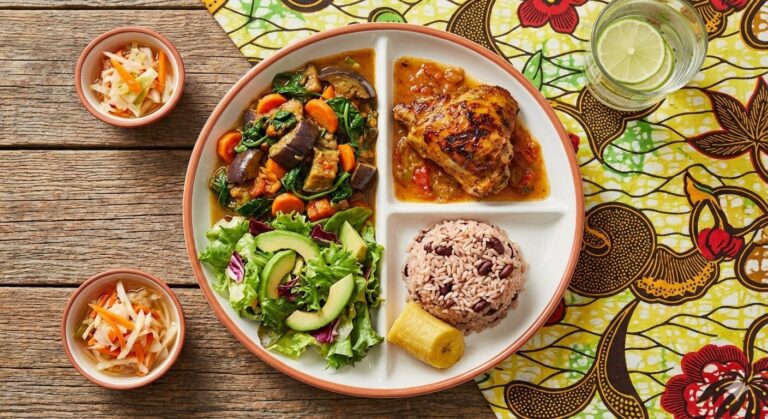
In a traditional setting, rice often takes up 75% of the plate, with the meat and vegetables acting as small garnishes. To stay healthy without giving up the flavor, we don’t need to change the ingredients, just the geography of the plate.
Try to visualize your plate in thirds rather than one giant mound of white:
- One-Fourth Diri ak Pwa: This provides your complex carbs and comfort.
- One-Fourth Protein: Whether it’s poul ak nwa, pwason (fish), or a lean kabrit (goat) stew, protein is essential for muscle maintenance and satiety.
- One-Half Fiber-Rich Vegetables: This is where we often fall short. We need more than just the two slices of tomato and a piece of watercress. Load up on legim (cabbage, eggplant, and spinach stew), steamed mirliton, lettuce & tomato, or a hearty beet and carrot salad.
By filling up on the fiber and protein portions of the plate first, you’ll find you feel satisfied with a moderate portion of rice rather than needing three helpings to feel “full.” Read more on the balanced plate method here.
4. Cook with “Functional” Ingredients
Don’t just boil your rice in plain water. In the Haitian kitchen, we have the tools to turn a simple grain into a functional food. By adding healthy fats and aromatics to the pot, you alter how your body metabolizes the meal.
- Healthy Fats: A spoonful of olive oil or a splash of coconut milk doesn’t just add flavor; the fats coat the starch granules. This further slows down gastric emptying (how fast food leaves your stomach), leading to better blood sugar control.
- The Epis Power: Your epis is full of garlic, scallions, and peppers. Garlic contains allicin, which has been shown to help improve insulin sensitivity.
- Spices: Using cloves (jirof) and turmeric adds anti-inflammatory properties. When you reduce inflammation in the body, your cells are better at “unlocking” to let sugar in, which prevents it from sitting in your bloodstream.
5. Sequence Your Bites (Eat in Order)
Believe it or not, the order in which you chew your food can change your clinical lab results.
Scientific studies on “food sequencing” show that if you eat your vegetables and protein before your carbohydrates, your post-meal blood sugar levels can be up to 30% lower than if you ate the same foods all at once or rice-first.
- The Strategy: Start your meal by eating a few bites of your salad or the vegetables in your stew. Follow that with your protein. Finally, enjoy your rice.
- Why it works: The fiber from the veggies creates a “mesh” in your intestines, and the protein triggers the release of a hormone (GLP-1) that tells your brain you’re getting full. By the time the rice hits your system, your body is primed to handle the glucose efficiently.
Finding Peace with Your Plate
As Black women, we are often told that our traditional diets are the reason for our health struggles. This narrative is not only frustrating; it’s often incorrect. Health isn’t about eating bland, “Westernized” salads every day. It’s about understanding how to use our traditional foods in a way that supports our modern lifestyles.
White rice isn’t your enemy. It’s a source of energy, a carrier of flavor, and a link to your ancestors. When you treat it with respect—by pairing it with fiber, cooling it for starch, and balancing your proportions—it can absolutely be part of a vibrant, healthy lifestyle.